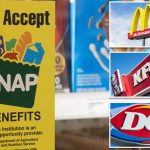
WASHINGTON — Oh, SNAP.
Quick-food chains, notably in California, have raked in additional than $524 million in taxpayer funds via the federal Supplemental Diet Help Program, or SNAP, up to now three years, in keeping with estimates from a gaggle of lawmakers.
Whereas government-subsidized SNAP is often supposed for at-home meals and beverage consumption for low-income People, its Restaurant Meals Program element, a ok a RMP, has expanded in lots of states since round 2019 and been loosened to permit members to eat at chains comparable to Subway, McDonald’s, Burger King, Wendy’s, KFC, Dairy Queen.
“SNAP is meant to feed hungry households with nutritious meals, however loopholes have funneled half-a-billion {dollars} to burgers and fries,” stated US Sen. Joni Ernst (R-Iowa), who’s main a gaggle of eight lawmakers urging Well being and Human Providers Secretary Robert F. Kennedy Jr. and Secretary of Agriculture Brooke Rollins to revisit the RMP program.
“I’m fed up with this fast-food feasting, so I’m partnering with the Trump administration to enhance the menu by including wholesome choices,” he informed the Publish.
“The ‘N’ in SNAP stands for ‘vitamin,’ in any case, not nuggets.”
The group needs HHS and USDA to evaluate whether or not there ought to be tighter guidelines pushing for extra wholesome eating places.
“What was initially supposed as a slender lodging for people unable to retailer or put together meals, this system has grown and is now dominated by giant nationwide fast-food and quick-service chains,” the GOP lawmakers wrote in a Thursday letter to Kennedy and Rollins.
“As USDA and HHS proceed advancing efforts to handle diet-related persistent illness via the MAHA initiative, it’s value inspecting whether or not the present RMP construction displays those self same priorities.”
There are at present 9 states enrolled in SNAP’s restaurant program: New York, California, Arizona, Michigan, Rhode Island, Massachusetts, Illinois, Virginia and Maryland.
Of these, California was liable for the majority of the government-fueled fast-food spending tabulated between June 2023 and Might 2025, clocking in at $475 million. It was adopted by Arizona at $41.4 million and New York at $.3.6 million.
State participation in this system had shifted over latest years. In 2003, 19 states enrolled in this system however solely 4 by 2018, in keeping with the lawmakers.
By 2019, that started to shift within the different course, with California increasing restaurant eligibility, which had been restricted to some counties, to a statewide phenomenon, with greater than 5,800 eating places concerned in RMP.
A number of different states received again on the RMP bandwagon, too, which additionally helped increase the restaurant business in these states.
RMP’s roots date again to the Meals and Agriculture Act of 1977, which created a carve-out to allow people with out ample meals storage or cooking alternatives to get assist shopping for meals. It wasn’t known as RMP on the time that legislation was handed.
Ernst was joined by US Reps. Ben Cline of Virginia, Beth Van Dune of Texas, Randy High quality of Florida, Brandon Gill of Texas, Daniel Webster of Florida, Michael Cloud of Texas and Mike Kennedy of Utah within the letter.
A rep for USDA informed The Publish that the division is “firmly dedicated to conducting rigorous integrity critiques throughout all USDA applications that serve our Nation’s most weak people.”