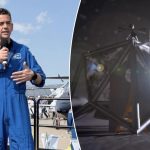
Fifty-seven years after Individuals first landed on the moon, NASA goes again — to not plant one other flag, however to construct a everlasting lunar base because it pushes to make people an interplanetary species.
It’s all a part of a massive push by the area company’s Administrator, Jared Isaacman, 43, to develop nuclear-powered spacecraft, develop an actual area economic system and ultimately put Individuals on Mars. The ambition comes at a time when the American public has by no means been extra enthusiastic about NASA.
“We’re polling at like 70% [for] America’s assist to return to the moon, which is double that of in the course of the Kennedy period,” Isaacman instructed me.
For NASA, the moon is foundational to any lasting presence past low Earth orbit. It might function a proving floor the place astronauts extract water ice and switch it into oxygen, hydrogen, and propellant — the fundamental constructing blocks of life and transportation.
The long-term aim is larger self-sufficiency, although Isaacman is cautious to not oversell it. “I don’t know who’s speeding to have the primary glass of moon water,” he quipped.
After the inspiring success of the Artemis II mission this previous spring, which marked the primary return to the moon in over half a century, NASA has an aggressive timeline within the coming years.
In 2027, it would launch Artemis III, which is able to put industrial lunar touchdown methods in low orbit, and begin sending robotic landers and rovers to the south pole on a near-monthly foundation to start setting up a base.
“The three strongest rockets on the planet are going to launch in a span of a couple of week. It’s going to be actually fairly cool,” Isaacman mentioned.
In 2028, NASA will endeavor to place astronauts again on the lunar floor with Artemis IV. This can lay the groundwork for the commercialization of area, with non-public firms constructing out their presence past Earth.
“If we do wish to have that extraordinary future that many people think about, you need to have some kind of an area economic system to fund it,” he mentioned.
That shift is already underway. Launch, Earth remark and communications have all moved from government-dominated tasks into markets the place non-public firms like SpaceX compete, innovate and drive down prices.
The subsequent problem is determining learn how to create extra worth in area than it prices to function there — and make missions sustainable if and when taxpayers develop uninterested in subsidizing NASA.
Early analysis means that among the most dear work in area could come from industries that profit from microgravity. Prescription drugs could be examined in an surroundings the place proteins crystallize in a different way, doubtlessly serving to researchers higher perceive illness and drug improvement. Organic supplies and organics could develop in methods which might be more durable to duplicate on Earth.
Orbital AI knowledge facilities, in the meantime, may gain advantage from steady solar energy and the flexibility to function with out the land, cooling, and group constraints that restrict them on the bottom. Whereas many of those are nonetheless moon pictures, that might change shortly over the approaching years.
“I’d not guess in opposition to the orbital knowledge facilities,” Isaacman mentioned.
We may lastly get a solution as to if there’s extraterrestrial life. Isaacman thinks there’s “an excellent likelihood” that samples returned from Mars within the subsequent decade or so will show microbial life as soon as existed there — and we might see related proof from different worlds, like a few of Saturn’s moons.
Isaacman, a personal astronaut and billionaire entrepreneur who made his fortune in funds, is uniquely positioned for this second.
He left highschool at 16, based what grew to become the fee firm Shift4 in his mother and father’ basement, and grew it right into a multibillion-dollar public firm listed on the New York Inventory Change.
“I’ve completely lived the American dream,” Isaacman mentioned. “None of that ought to occur and solely did due to the nation that we stay in proper now.”
He was captivated by area from a younger age: As a kindergartener, he instructed his instructor he would turn into an astronaut, and he later grew to become a pilot as a result of he thought that was the closest he would ever get. It wasn’t.
In 2021, he commanded Inspiration4, the primary all-civilian orbital mission. In September 2024, on the privately funded Polaris Daybreak mission, he grew to become the primary non-public astronaut to conduct a spacewalk.
When President Trump nominated him to run NASA just a few months later, in early December 2024, Isaacman had solely not too long ago returned to Earth.
“There was no manner I used to be going to show it down,” he mentioned of the out-of-this-world alternative. “I had no downside strolling away from my different life … I had an enormous debt to repay to the nation.”
He introduced his non-public sector ethos and Silicon Valley ethos with him to NASA — pushing it away from its bureaucratic background right into a leaner and extra environment friendly operation.
“We’ve acquired to cease making an attempt to please everyone proper now, we want excessive focus,” he mentioned. “We’re imagined to be doing what no different authorities company, no firm is able to doing, no different nation all over the world.”
That has meant specializing in nuclear energy and propulsion. NASA is focusing on the launch of its first nuclear-powered spaceship in 2028.
It’s additionally meant attacking inside inefficiency. Roughly 75% of the company’s workforce, greater than 40,000 folks, are contractors.
“As a taxpayer that ought to actually hassle you,” he mentioned. “It’s $4.5 billion a 12 months that we’re paying to lease our workforce.”
NASA is now reversing that mannequin, he mentioned, by bringing contractors into civil service roles tied to core competencies: designing, constructing, testing, launching, and working spacecraft.
“It’s saving taxpayers plenty of cash with out canceling a program or firing anybody,” Isaacman famous.
A part of Isaacman’s urgency comes from an acknowledgement that America is in a brand new area race with China.
“We’re not going to lose,” he mentioned.
And the problem is price it as a result of — as figures like Isaacman and Elon Musk describe it — it’s about diminishing humanity’s “large focus danger on Earth” if and when one thing occurs to our planet.
Nonetheless, for all of his ambition and enthusiasm, Isaacman is pragmatic about what the longer term in area would possibly really be like — extra Antarctic expedition than glamorous trip.
“Mars goes to suck to stay in. You’re going to stay in a bubble. You’re going to get pelted with radiation on a regular basis. You’re by no means going to have a seashore day,” he mentioned. “Earth is the good home within the neighborhood. Just about every part in our photo voltaic system goes to be a big step down from Earth.”
However he’s very excited in regards to the future — each within the close to time period and in the long run.
“I can’t anticipate Halloween as a result of I feel the variety of youngsters dressing up as astronauts for Halloween might be probably the greatest indicators of how good of a job we’re doing,” he mentioned. “I think the numbers shall be up this 12 months.”