Why go to school to broaden your views, when you possibly can spend 4 years in an echo chamber canceling all dissenters?
Sociology professor Neil Gross explores why increasingly children are selecting the latter possibility — and placing our democracy as we all know it in danger — in his aptly titled guide, “What Occurred to Faculty?: How Politics Broke Greater Training and What We Can Do to Repair It” (Avid Reader Press), out in the present day.
“The restructuring of undergraduate life alongside political strains is on the core of the present disaster,” he argues. “When every part turns into political, life simply loses a few of its worth and a few of its richness.”
Writing from contained in the ivory tower at Colby Faculty in Maine, Gross argues that the basic drawback with increased ed is that politics “has turn into the central organizing precept of the undergraduate expertise,” dictating how college students select lessons, pals, golf equipment, companions and even majors.
However the professor advised The Publish that the problem begins even earlier, when college students resolve to “self-segregate by political affiliation” after they select which schools to use to. In line with his polling information, a full half of undergraduates are assessing “political match” when schools.
Some children, Gross discovered when researching the guide, are searching for out colleges, like Oberlin and Barnard, with a status for scholar activism, whereas others are searching for apolitical campuses the place they’ll have enjoyable. More and more, he’s additionally listening to about ladies boycotting colleges in states with abortion bans, too.
The universities themselves are making the political polarization worse as they’ve “actually leaned into” their reputations by advertising and marketing themselves to college students of a specific political stripe.
Gross notes how schools make use of “refined messaging” on faculty excursions and in brochures — celebrating sure visitor audio system and alumni — to convey their leanings.
Extra explicitly, UC Berkeley’s undergraduate admissions web page celebrates its historical past of activism.
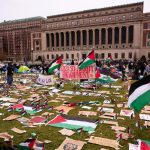
On the flip aspect, Gross has seen an rising development of some colleges positioning themselves as “impartial” to court docket children who is perhaps turned off by rampant campus protests like those who unfold throughout the nation post-October seventh.
Vanderbilt and the College of Chicago, he famous, have made inroads with extra reasonable or politically alienated children by “advertising and marketing themselves as locations the place college students can go without spending a dime speech.” The College of Chicago foregrounds its dedication to free speech on its web site.
However the latest development that’s sorting children into ideological buckets as they apply to high schools is an rising attraction by Southern colleges to children within the North turned off by campus politics, a shift The Publish has reported on beforehand.
“[Many students] now really feel that colleges within the south are… a greater place to go,” Gross stated. “It’s additionally some fairly strategic advertising and marketing on the a part of colleges: ‘Okay, effectively, we’re going to be a faculty [where] you possibly can go … and you’ll simply have enjoyable and luxuriate in your self, and also you don’t should get caught up in these political controversies.’”
He worries all this political advertising and marketing is creating campus echo chambers the place there ought to be debate: “I don’t assume it’s actually good for college kids. What actually results in the very best expertise is if you’ve received a mixture of folks with totally different views.”
The political polarization solely will get worse as soon as children arrive on campus and hunt down folks who share their views. He experiences within the guide that college students choose roommates, select romantic companions, decide majors, pursue friendships and even shun different college students based mostly on political affiliation.
One self-identified Democrat at an elite liberal arts school advised him that conservatives on his campus have been an “remoted and resentful” group that socialized amongst themselves, whereas the progressive majority have been intellectually “lazy” and their “incentive [in discussing politics] isn’t towards fact” however fairly “social acceptance.”
He additionally heard from college students that romance is oriented round politics, to the extent that “some conservatives have been recognized to masks their id by carrying liberal-seeming garments, or letting their hair develop out.”
“If college students can do little greater than rehearse speaking factors they’ve heard of their social media bubble, they gained’t study the instruments of constructive dialogue or know the fun that comes from creating an unique argument,” he warned.
Gross, a liberal Democrat, blames schools themselves for creating this mess.
“These establishments offered precisely what so many progressive college students … have been searching for: a university expertise the place they wouldn’t have to interact an excessive amount of with conservatives or their concepts,” he writes. “Elite schools and their school ought to have recognized this wouldn’t end up effectively.”
Gross says there are just a few easy reforms colleges can readily make, like randomizing roommate choice to introduce children who assume otherwise, and even requiring openness to totally different views in admissions selections.
He asserts that finally, if colleges proceed to supply lessons of highly-educated younger individuals who don’t know what the remainder of the nation thinks or believes, our social cloth will additional tear.
“In order for you a greater democracy, it is best to care about what occurs in increased schooling,” Gross stated. “When folks simply vehemently hate these on the opposite aspect… the entire regular mechanisms of democracy start to operate much less effectively.”