What the F?
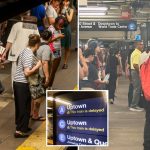
Huge Apple subways are dealing with an uptick in delays this yr — however the MTA seems extra targeted on the long run, touting enchancment tasks which can be many years away.
Weekday on-time efficiency slipped 1.7 share factors systemwide, from 83.7% within the first half of 2025 to 82% within the first half of 2026, in accordance with MTA knowledge.
Meaning practically one in 5 weekday journeys did not arrive on time and a few strains have been far worse.
The B, N, 2 and F strains posted the bottom weekday on-time charges, at 71.6%, 72.7%, 73% and 73.1%.
Huge Apple straphangers sounded off on Friday about their very own experiences with the subway delays.
Sal Padellaro, 33, recalled he was as soon as caught on a stalled F practice for minutes.
“I bear in mind smoke barreling into the practice automotive,” Padellaro informed The Submit whereas ready for the A practice at fiftieth Road.
“It’s laborious to be underground with no service that lengthy,” he added. “My household, my boyfriend, everybody was making an attempt to come up with me.”
Ana, who has lived in Manhattan and ridden the subway her entire life, stated the 6 practice is a drag.
That line dropped from 85.3% to 76.3% on weekdays — a 9-point fall, the steepest of any line within the system.
“The 6 practice will say two minutes after which it takes ten minutes till the practice comes. It’s crowded and persons are pushing and shoving and preventing as a result of they need to get in,” stated Ana, who declined to offer her final identify.
She stated she could be written up if she is late to her job in hospital billing.
Delay verification notes that the MTA gives can take days to reach and wouldn’t assist her anyway, she griped.
Padellaro, too, stated late trains throw off his workday.
“I’ve workers that report back to me, and you need to work with a number of completely different practice schedules being late, which delays folks attending to work, which might damage enterprise and sure operations,” he stated.
The 7, J and L trains have been essentially the most dependable strains, arriving on time 89.1%, 86.4% and 85.4% of the time on weekdays.
The forty second Road, Franklin Avenue and Rockaway Park shuttles all topped 96% for on-time efficiency. Every runs a brief stretch of observe with no different trains merging in.
The MTA counts a practice as on time if it reaches its ultimate cease not more than 5 minutes late with out skipping any deliberate stations.
The subway’s on-time fee has largely hovered within the low-80s since 2021 — up from 63% in 2017 when then-Gov. Andrew Cuomo declared a state of emergency.
MTA Chairman Janno Lieber stated Wednesday the company is working to enhance delays.
“How rapidly are our signaling groups responding? How rapidly are we resolving points that contain the police? Are we ensuring that anyone will get to the sick passenger rapidly in order that service can resume?” Lieber stated.
Lieber famous that snow storms in Febuary tanked on-time performace for the month, dipping to 79% systempwide.
The MTA additionally has plans to deal with infractuture tasks to root out the supply of many delays — however most of that work is many years out, in accordance with a presentation officers gave at a board assembly this week.
“Our imaginative and prescient for 2050 will embrace fewer bottlenecks and higher service,” one slide proudly proclaimed.
“I’ll be useless,” Padellaro joked. “That’s so unreasonable.”
The report, titled “Eliminating Bottlenecks: Dashing Up Your Experience,” lays out work to repair 25 chokepoints the place trains from completely different strains merge and gradual one another down.
A single delay at one among these spots can unfold throughout a number of strains and snarl service citywide, the MTA stated.
A lot of the MTA’s chokepoint options will materialize between 2030 and 2050.
Even two Brooklyn chokepoint tasks the company has already began on gained’t be completed by the point the subsequent deliberate fare hike lands in March 2027.
“That sucks,” Ana stated. “If it’s not good service why hike the worth? It’s unhealthy sufficient folks aren’t making sufficient and the price of all the pieces is up.”
The report casts the chokepoints as an issue the MTA inherited.
“The New York Metropolis subway system—constructed over a century in the past as three separate networks later stitched collectively—comprises bodily constraints that restrict the frequent and dependable service that we attempt to supply to riders,” the report stated.
The MTA was put in control of New York Metropolis’s subway system within the Nineteen Sixties.