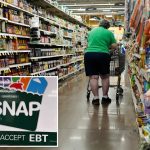
Enrollment within the largest federally funded meals assist program within the US dropped by greater than 13% in a 12-month span — a decline far steeper than the federal government estimated as work necessities and different provisions of President Donald Trump’s “massive stunning invoice” take maintain.
These shedding protection within the Supplemental Vitamin Help Program, or SNAP, embrace individuals who don’t meet the tightening necessities to take part, and, advocates say, some who qualify for the assistance however are rejected as a result of they miss deadlines or don’t have the wanted documentation helpful. It’s too early to inform precisely what number of fall into every group.
It’s additionally unclear what number of have misplaced protection as a result of some state businesses that run the packages are overwhelmed making an attempt to maintain up with modifications. That was the case in Arizona, which noticed the nation’s largest enrollment drop.
Tia Fields, who analyzes social security internet insurance policies on the advocacy group Spend money on Louisiana, stated the principle motive she’s seeing individuals lose protection just isn’t failure to satisfy work necessities. “Plenty of it’s administrative paperwork,” she stated.
Proponents of welfare reform hope the roll reductions are pushed by individuals incomes an excessive amount of to maintain qualifying — an indication that coverage modifications are behaving as supposed for a program they assert is riddled with fraud.
“If there are individuals which are leaving the welfare rolls as a result of they’re working and so they’re transferring ahead,” stated Rachel Sheffield, a analysis fellow on the conservative Heritage Basis, which pushed for stricter necessities for SNAP, “that may be a step ahead.”
Arizona has had the steepest decline thus far, with a 12-month drop of greater than 50%, in line with information compiled by the US Division of Agriculture, which runs SNAP. The decline was greater than 20% in Georgia, Louisiana and Nevada — and in Florida, the place the Division of Kids and Households stated in an announcement that the reducing quantity “is reflective of the state’s robust concentrate on advancing alternatives for Floridians and their households to attain financial self-sufficiency.”
Eligibility necessities are tightening
SNAP helps greater than 1 in 10 individuals within the US purchase meals. Many of the beneficiaries have incomes under the poverty line. The month-to-month profit, which is delivered on debit playing cards that can be utilized just for groceries, is $344 per family on common.
Newly launched federal information discovered SNAP enrollment fell from 42.2 million in Might 2025 to 36.6 million in Might, a drop of greater than 13% in a yr. The Might information are preliminary and may very well be revised.
Since 2010, the typical variety of month-to-month beneficiaries has been under 40 million for under two years — 2019 and 2020. The rolls began dropping after a current peak of 43.3 million in October 2024. They’ve fallen a lot quicker since implementation started final yr for Trump’s “one massive stunning invoice,” which minimize taxes and overhauled social security internet packages.
The expanded SNAP work requirement has now kicked in for a lot of the nation, but it surely gained’t start in some locations till subsequent yr.
Many adults 54 and youthful with out minor kids have lengthy been required to work to get SNAP advantages. The brand new regulation requires most individuals who beforehand had been exempt from necessities to both work, volunteer or go to highschool to get advantages. It now consists of these ages 55 to 64, and people with kids ages 14 to 17. These 65 and older or with kids youthful than 14 stay exempt, as do these with well being limitations. Another teams that had been exempted from the requirement — together with homeless individuals — now not are.
In February, the Congressional Finances Workplace projected that the brand new necessities and different elements would push SNAP enrollment down over the following decade, falling under 34 million by 2036. However the nonpartisan workplace didn’t anticipate the drop to be as quick because it’s been. By Might, the variety of individuals receiving the advantages was about as little as it was forecast to go in 2030.
Specialists anticipate one other impression when states are required to pay a part of the price of advantages if their charge of cost errors — when recipients obtain kind of than they need to — is above 6%. Advocates for recipients say states might deny advantages to some individuals solely quite than threat errors.
The associated fee-sharing is scheduled to begin in October 2027, although Congress has thought-about a delay.
Adjustments have been exhausting to implement in Arizona
In Arizona, enrollment plummeted by 55% from April 2025 to April 2026 — the largest drop within the nation, with greater than 400,000 fewer individuals getting advantages now.
The state stated the drop was pushed largely by the state’s personal struggles placing new federal necessities in place.
“Implementing the federally mandated modifications triggered unprecedented name volumes and administrative hurdles, together with extra verification necessities, creating actual limitations for candidates,” stated Brett Bezio, a spokesman for the Arizona Division of Financial Safety.
Bezio stated that hiring extra employees members and introducing methods for individuals to submit their paperwork on-line have stemmed the enrollment drop in current months because the state has diminished the possibility for individuals who qualify to lose advantages.
In Phoenix, LaDiamond Lopez misplaced her advantages in January, with officers telling her she wanted extra documentation about her earnings and family — one thing that’s wanted for officers to find out whether or not enrollees meet work necessities.
She’s been skipping meals and a few invoice funds to make sure her kids have sufficient to eat.
In her quest to be reinstated, she had earlier employers signal types confirming she now not labored for them and added her kids — ages 3 and 9 — to her condominium lease. She anticipated funds to renew in August, however she doesn’t know in the event that they’ll final.
“I used to be permitted on the finish of Might, however now they’re asking me for extra paperwork,” she stated. “It’s a panic.”
Different elements may very well be driving down enrollment
The Heritage Basis’s Sheffield says that a few of the drop in SNAP use is probably going a pure decline after peaks within the coronavirus pandemic period.
Paco Velez, the president and CEO of Feeding South Florida, stated the 22% one-year enrollment drop in Florida is pushed partly by immigrants who’re within the US legally however concern being focused by Trump’s immigration crackdown in the event that they’re in search of authorities advantages.
Spend money on Louisiana’s Fields stated SNAP enrollment declines have broader penalties. As an illustration, kids in households that obtain the profit might be routinely enrolled in free college lunch packages or within the SNAP for Girls, Infants and Kids program for low-income moms, younger kids and expectant mother and father in the event that they meet the opposite standards.
“What occurs when that little one can’t pay for lunch?” she requested.
Some meals banks have ramped up donations to attempt to meet a requirement that they are saying has risen as SNAP rolls have declined. However that isn’t anticipated to bridge the hole totally.
“We’re very anxious about it as a result of we all know that no different group or program can replicate the dimensions and success of SNAP,” stated Carolyn Vega, a coverage analyst on the advocacy group Share Our Energy. “We all know that colleges can’t fill this hole. We all know that meals banks can’t fill this hole.”