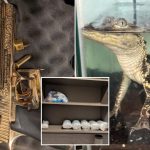
ABBEVILLE, La. — Jacob Sagrera unrolls an alligator pores and skin and lays it flat on a steel desk, disregarding flecks of salt. He holds it as much as the sunshine, in search of blemishes, and provides it a rating.
That rating will assist a tannery an ocean away put together it for use by a luxurious designer — for objects like boots, watch bands and purses destined for vogue runways and posh retailers.
Then he provides it to a pile of hides, every with a yellow monitoring tag that enables authorities to implement authorized commerce.
Advocates say industrial alligator farming has helped protect a species typically seen as scary, bothersome or good just for their skins.
Not all conservationists assume that’s a very good factor, however for the farmers and luxurious manufacturers searching for to market their merchandise as sustainable, it’s made sense to tie conservation to capitalism.
Among the scientists who research them agree.
“These wetlands, these alligators … it has to have some form of financial worth,” stated George Melancon, alligator analysis biologist for the Louisiana Division of Wildlife and Fisheries. “In any other case, individuals simply neglect about them.”
How alligator farming works
Sagrera’s grading work at his household’s operation, Vermilion Gator Farm, is only one step in a decades-old system.
American alligators had been as soon as in peril of being hunted to extinction, and went on the Endangered Species Checklist a long time in the past.
Their numbers weren’t too depleted to rebound within the wild if their habitat was maintained, say some consultants, together with Grahame Webb, director of Wildlife Administration Worldwide and an adjunct professor at Charles Darwin College in Australia who has labored on reptile and crocodilian conservation because the Nineteen Sixties.
However scientists with the state of Louisiana proposed a distinct approach to increase their numbers: farmers would pay landowners for eggs, increase the gators to promote their meat domestically and their skins on the posh market after which launch some again into the wild yearly.
Now, Louisiana produces round 400,000 farmed alligators yearly, in accordance with the state’s wildlife & fisheries division, which valued farmed skins in 2024 at over $56 million.
The state decides what number of younger alligators to launch yearly on information from nest surveys and searching tags, and estimates round three million alligators now within the wild in Louisiana.
As wild numbers have grown, they’ve dropped the proportion of farmed gators returned every year, from nearly 20% within the early 2000s to about 5% now.
American alligators had been delisted as endangered in 1987 however are actually a species of “Least Concern” on the IUCN Crimson Checklist of Threatened Species, although their commerce continues to be regulated due to how comparable they give the impression of being to different, extra susceptible crocodilian species.
Alligators could be discovered throughout the Southern US, however Louisiana is by far the biggest producer, with farms additionally in Georgia, Florida and Texas.
Farmers and state officers say the trackers assist guarantee each product got here from a authorized operation.
One firm that sells alligator leather-based items, Col. Littleton in Lynnville, Tennessee, retains data of all its monitoring tags, stated Hayley Holt, their director of company and specialty gross sales.
They largely promote inside the US, however many retailers log the place they sourced their supplies in case they need to ship merchandise internationally, Holt stated.
Alligator farming advantages from a big authorized market and powerful regulation, stated Oliver Tallowin, senior program officer on wildlife use and commerce for the Worldwide Union for Conservation of Nature and Pure Assets.
Some animal rights advocates query the ethics of elevating alligators on farms. Past welfare considerations, some assume the follow perpetuates demand for skins that may gas poaching.
“That shadow trafficking business goes to be there since you’ve rooted your system in revenue,” stated Sarah Veatch, principal for wildlife coverage for the nonprofit Humane World for Animals, previously the Humane Society of america.
“Commerce not solely meets the present demand, nevertheless it normalizes it, it legitimizes it and it grows that demand for wild animal skins.”
The alligator program and the way forward for luxurious vogue
When manufacturers market high-end objects, sustainability is usually a part of the pitch.
Manufacturers have taken a extra lively function in sourcing alligator leather-based by shopping for shares in or buying family-operated farms, tanneries and producers, stated Christy Gilmore, a marketing consultant who communicates between Louisiana alligator officers and the Conference on Worldwide Commerce in Endangered Species of Wild Fauna and Flora (CITES), a commerce settlement amongst world governments.
“The manufacturers began asking questions and digging deeper and fairly actually, simply doing issues that these of us who had been small household companies didn’t take into consideration,” stated Gilmore, whose household has been within the cover enterprise for over a century and owns an alligator and crocodile tannery in Georgia.
“We’re not sitting round occupied with what our carbon footprint has been.”
In the meantime, the state wildlife and fisheries company has elevated its advertising price range over time, from a cap of $300,000 to $500,000. That cash comes from the business, together with gross sales of searching tags every year, and goes right into a fund devoted to alligator applications.
The price range has gone up as they’ve had more cash to spend and due to competitors with hides from different crocodilian species coming into the market, stated Jeb Linscombe, alligator program supervisor for the Louisiana Division of Wildlife and Fisheries.
However there’s additionally been concern that animal rights teams might push the posh market away from alligator hides, Linscombe stated.
A associated business, fur, has seen vital declines lately. Final yr, Poland handed a regulation to finish fur farming by the tip of 2033, and New York Style Week introduced it could ban fur for its fall 2026 reveals.
Some animal rights teams assume hides like gator and python might be the subsequent goal. Some smaller venues, like London Style Week, have already banned unique skins.
New analysis on alligators, together with function in local weather change
The alligator program additionally drives analysis on a species that has lengthy been a thriller.
Melancon, the alligator biologist, needs to higher perceive their biology to assist ranchers — as an example, creating a vaccine towards West Nile virus, which may trigger pores and skin lesions that harm the precious hides.
Different researchers need to examine whether or not alligators are a local weather profit.
A research within the journal Scientific Experiences final yr discovered a powerful correlation between the abundance of alligators in a wetland and the way a lot carbon that wetland shops. That’s necessary as a result of when launched into the environment, carbon dioxide is a major trigger of world warming.
That crew is creating one other research to see whether or not gators instantly contribute to carbon storage, presumably by consuming animals that nibble carbon-storing vegetation, stated lead creator Chris Murray, an adjunct professor of biology at Southeastern Louisiana College.
“Alligators can’t cease local weather change,” Murray stated, however “there’s the possibility they’re taking part within the world problem of local weather change for the great and never the dangerous.”
Murray stated he’s not doing the analysis to assist the business, however for conservation on the whole. He sees worth in gators past luxurious luggage and he needs others to see it, too.
“It’s extra than simply this cool factor for youths to have a look at,” Murray stated. “It’s, ‘hey, they’ve an necessary function within the performance of the earth that you simply stay in.’”