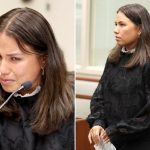
A California appeals court docket backed a white woman who was punished by her faculty and referred to as racist for writing “any life” drawing harmless thumbprints of her mates below “Black Lives Matter” image at college.
The woman, recognized as “B.B.” in court docket paperwork, in 2021 drew the image and gave it to a black classmate, “M.C.,” after listening to a narrative concerning the Rev. Martin Luther King Jr. at school.
Beneath a ”Black Lives Matter” illustration, M.C. poignantly wrote ”any life” and marked the paper with 4 drawings of her mates with totally different pores and skin shade thumb prints.

However when M.C. took the image dwelling, her mother raised considerations with the B.B.’s mother, Chelsea Boyle, and the varsity.
Jesus Becerra, the principal of Viejo Elementary College, in Mission Viejo, informed the woman her drawing was racist, compelled her to apologize to M.C., and banned her from recess for 2 weeks.
Boyle later filed go well with towards the varsity, alleging B.B.’s First Modification rights had been violated.
The decrease court docket disagreed, concluding the drawing was not protected speech and interfered with the black scholar’s proper to be not to mention.
However the appeals court docket overruled the choice primarily based on the landmark 1969 ruling in Tinker v. Des Moines Impartial Group College District case, which established highschool college students had the correct to protest the Vietnam Warfare.
“This case presents an necessary problem: to what extent is elementary college students’ speech protected by the First Modification?” the three-judge panel wrote in a per curiam opinion.
“We maintain that elementary college students’ speech is protected by the First Modification, the age of the scholars is a related issue below Tinker, and faculties could prohibit college students’ speech solely when the restriction is fairly needed to guard the protection and well-being of its college students,” the judges discovered.
”As a result of the Tinker evaluation raises real points of fabric reality, we vacate the grant of abstract judgment and remand,” they added.
The decrease court docket decide, U.S. District Decide David Carter, a Invoice Clinton appointee, argued that age was a consider his determination.
“Thus, the downsides of regulating speech there may be not as vital as it’s in excessive faculties, the place college students are approaching voting age and controversial speech might spark conducive dialog,” Carter wrote.

However the increased court docket stated age is a related however “non-dispositive” issue.
“Disagreeing with the district court docket’s dedication that the drawing was not protected by the First Modification, the panel held that elementary college students’ speech is protected by the First Modification, Tinker applies within the elementary scholar speech context, and elementary college students’ younger age is a related, however non-dispositive, issue,” the panel wrote.
Boyle celebrated the upper court docket’s determination.
“This isn’t only a win for my daughter. It strengthens constitutional protections for college students throughout the nation,” she wrote in an Instagram put up.
“Seems…The Structure doesn’t have an age restrict,” she added.
Her attorneys adopted go well with.
“At the moment’s ruling affirms what must be apparent: College students don’t lose their constitutional rights simply because they’re younger,” Caleb Trotter, senior legal professional at Pacific Authorized Basis, stated in a launch printed on-line. “The Structure protects each scholar’s proper to free expression. No little one must be punished for expressing a well-intentioned message to a buddy.”
The case will now return to the U.S. District Court docket for the Central District of California, per Courthouse Information.