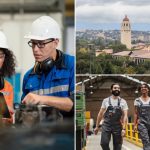
For a rising variety of younger Californians, the standard path from highschool to a four-year faculty is not trying like the one path to a middle-class profession.
Rising faculty prices, uncertainty in regards to the job market and considerations over synthetic intelligence are pushing extra younger folks to think about careers that require hands-on coaching as an alternative of a bachelor’s diploma.
The shift is displaying up in commerce packages and apprenticeship purposes throughout California.
Nationally, enrollment at public two-year establishments centered closely on vocational and commerce training has climbed sharply because the pandemic.
The Nationwide Scholar Clearinghouse Analysis Middle reported that enrollment at these faculties reached about 871,000 college students in spring 2025 — practically 20% greater than in spring 2020.
That development has continued, though at a slower tempo. In spring 2026, enrollment at high-vocational public two-year schools elevated one other 2.8%, or roughly 24,000 college students, based on the Clearinghouse report.
California is especially nicely positioned for the pattern.
The state’s neighborhood faculty system says it’s the largest supplier of workforce coaching on the planet, providing greater than 200 profession teaching programs, together with automotive know-how, engineering and expert crafts. Officers say many packages might be accomplished in lower than a 12 months, with programs costing $46 per unit.
And college students are more and more competing for spots in a few of the state’s apprenticeship packages.
In Los Angeles County, the Electrical Coaching Institute in Commerce — which trains electricians via an apprenticeship program — says its software home windows can shut as soon as 2,000 purposes have been obtained.
The institute’s 2026 software schedule lists a number of home windows, together with one in July that closed after reaching the applying restrict.
The enchantment is simple: as an alternative of spending 4 years paying for faculty earlier than coming into the workforce, apprentices can prepare for a talented occupation whereas gaining hands-on expertise.
California has practically 100,000 energetic registered apprentices, based on the California Group Schools Chancellor’s Workplace, which has made apprenticeships a central a part of its workforce technique.
The system says apprenticeships mix classroom instruction with hands-on profession coaching and may result in high-wage careers with out scholar mortgage debt.
That may be notably enticing in California, the place the price of a four-year diploma can shortly add up.
On the College of California, a California resident coming into as an undergraduate within the 2026-27 educational 12 months faces $14,202 in annual tuition, plus a $1,386 Scholar Providers Price, earlier than housing, meals, books and different bills.
Commerce packages, by comparability, are usually designed round getting college students into a selected occupation fairly than requiring years of basic training earlier than they start working.
The California Group Schools Chancellor’s Workplace has additionally made profession training a central a part of its Imaginative and prescient 2030 initiative, which goals to extend the variety of college students finishing profession packages and discovering jobs of their fields whereas increasing pathways into in-demand occupations.
The shift doesn’t imply younger persons are abandoning faculty altogether.
Group faculty enrollment general rose 3.1% in spring 2026, whereas public four-year enrollment elevated 1.5%, based on the Nationwide Scholar Clearinghouse.
However vocational-focused schools are persevering with to put up good points, whereas enrollment in some historically widespread fields is transferring in the wrong way.
Pc and knowledge sciences, for instance, noticed undergraduate enrollment fall sharply from the earlier spring — down 8.4% at four-year establishments and 11.2% at two-year establishments.
On the identical time, well being professions enrollment elevated throughout award ranges and establishment varieties for a 3rd consecutive 12 months.