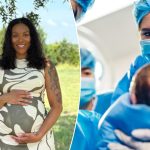
A child on the middle of a bitter authorized battle over whether or not he ought to have been aborted was born this week with a critical and uncommon coronary heart defect.
Surrogate McKenna West was about 20 weeks pregnant when the infant she was carrying, Gabriel, was recognized with hypoplastic left coronary heart syndrome, a congenital coronary heart defect that requires a number of surgical procedures and leaves survivors dealing with lifelong medical care and probably critical well being issues.
West refused the organic mother and father’ request to terminate the being pregnant, setting off a dispute that has concerned courts and officers in three states.
The organic mother and father had requested West to get an abortion, in accordance with the “abortion on demand” clause of their surrogacy settlement. West refused and traveled to Texas “for defense,” Texas Legal professional Normal Ken Paxton’s workplace mentioned.
“Each life issues. No girl must be compelled to finish the lifetime of the infant she is carrying — together with me… Child Gabriel ought to obtain an opportunity at life,” West informed The Submit in a press release.
The organic mother and father, Nausheen Gilkar and Omar Ahmed of California, have taken custody of Gabriel, however West plans to proceed combating for custody of the infant.
So what precisely is hypoplastic left coronary heart syndrome, and what does it imply for Gabriel?
What’s hypoplastic left coronary heart syndrome?
Hypoplastic left coronary heart syndrome (HLHS) is a extreme start defect wherein the left facet of the center is underdeveloped.
This space of the center consists of the left ventricle, valves and aorta. It’s accountable for receiving oxygenated blood from the lungs and getting it delivered across the physique.
HLHS impacts about one in 3,846 infants born within the US yearly.
What are the signs and issues of HLHS
A child born with HLHS might have:
- Issue respiratory
- Issue feeding
- A weak pulse
- Blue, purple or grey lips, pores and skin and nails. The situation is named cyanosis, and occurs when occurs as a result of there may be not sufficient oxygen within the blood.
- Chilly palms and toes
- Lethargy — sleepiness or being much less responsive
With out remedy, kids born with HLHS might go into shock, and can die from issues together with coronary heart failure.
How is hypoplastic left coronary heart syndrome recognized?
Infants will be recognized earlier than or after start. Earlier than start, ultrasounds or echocardiograms (ultrasounds of the center) can detect the situation.
After start, they’re recognized based mostly on the presenting signs, like issues with respiratory, feeding and pores and skin coloration. Docs might take heed to the center to detect a murmur or “whooshing” sound.
How deadly is HLHS? And what does dwelling with HLHS seem like?
HLHS is deadly if left untreated. A child will solely survive for just a few weeks at most, in line with New York Presbyterian.
With remedy, 72% of youngsters survive to age 5. In the event that they survive to age 5, 90% survive to maturity (age 18). The oldest individual to outlive HLHS is of their 30s.
Those that survive following the mandatory surgical procedures want lifelong care.
“Whereas these procedures enhance circulation, the center doesn’t operate the identical method as a typical two-ventricle coronary heart,” the American Coronary heart Affiliation writes. “Because of this, some folks might develop well being issues over time associated to blood movement via the center and lungs. Lifelong follow-up care is necessary.”
Some kids ultimately require a coronary heart transplant, even when all these procedures are finished. This requires longterm care like immunosuppressants to maintain the physique from rejecting the brand new coronary heart.
How is hypoplastic left coronary heart syndrome (HLHS) handled?
In some uncommon instances, infants will be handled whereas nonetheless within the womb, however this can be a “excessive stakes, extremely technical process like this takes great coordination between specialties,” mentioned Dr. Sarah Gelehrter, a heart specialist who led this process efficiently.
Not all HLHS infants are candidates for this. Often, there are a sequence of three operations wanted within the days and weeks after start.
First, HLHS infants endure the Norwood process, which permits the precise ventricle to pump blood across the physique — usually it solely pumps to the lungs. This requires making a brand new path (aorta) from the ventricle to the physique, and creates one other path (referred to as a shunt) to get blood to the lungs.
At 4 to 6 months, a second operation referred to as the Glenn process is required. This enables blood from the higher physique (head and arms) to movement to the lungs to get oxygen.
Lastly, at age two to a few, the Fontan process, redirects blood from the decrease physique to passively movement to the lungs. This enables blood to movement from the center to the physique and return to the lungs to get oxygen, which is most like a “regular” blood movement.